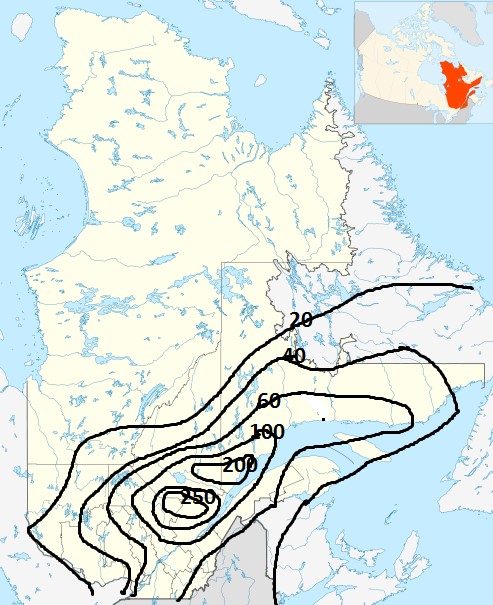
Severe storms triggered catastrophic flooding along the Saguenay River in Quebec, Canada. 488 homes were destroyed, 1,230 damaged, 16,000 people evacuated, and 10 people died.
This natural disaster became one of the most expensive environmental events in Canadian history, causing extensive damage to infrastructure, homes, and local communities. British Open Men's Golf, Royal Lytham & St. Annes: American Tom Lehman wins his only major championship
**"Read More" BELOW for the complete story**
The unprecedented rainfall led to massive river overflow, resulting in significant economic and environmental consequences.
The Saguenay flood was a series of flash floods on July 19 and 20, 1996 that hit the Saguenay–Lac-Saint-Jean region of Quebec, Canada. It was the biggest overland flood in 20th-century Canadian history.
Problems started after two weeks of constant rain, which severely engorged soils, rivers and reservoirs. The Saguenay region is a geological graben, which increased the effect of the sudden massive rains of July 19, 1996. In two days, rainfall accumulated that was "equivalent to the volume of water that tumbles over Niagara Falls in four weeks."
Over 8 feet (2.4 m) of water flooded parts of Chicoutimi and La Baie, completely levelling an entire neighbourhood. Estimates reach CA$1.5 billion in damages, a cost made greater by the disaster's occurrence at the height of the tourist season.
Post-flood enquiries discovered that the network of dikes and dams protecting the city of Chicoutimi was poorly maintained. In the end, 488 homes were destroyed, 1,230 damaged, 16,000 people evacuated, and 10 people died. An additional 2 people died in the mudslides produced by the incredible rain.
British Open Men's Golf, Royal Lytham & St. Annes: American Tom Lehman wins his only major championship by 2 strokes from Mark McCumber and Ernie Els; first American to win at Lytham since Bobby Jones 70 years earlier